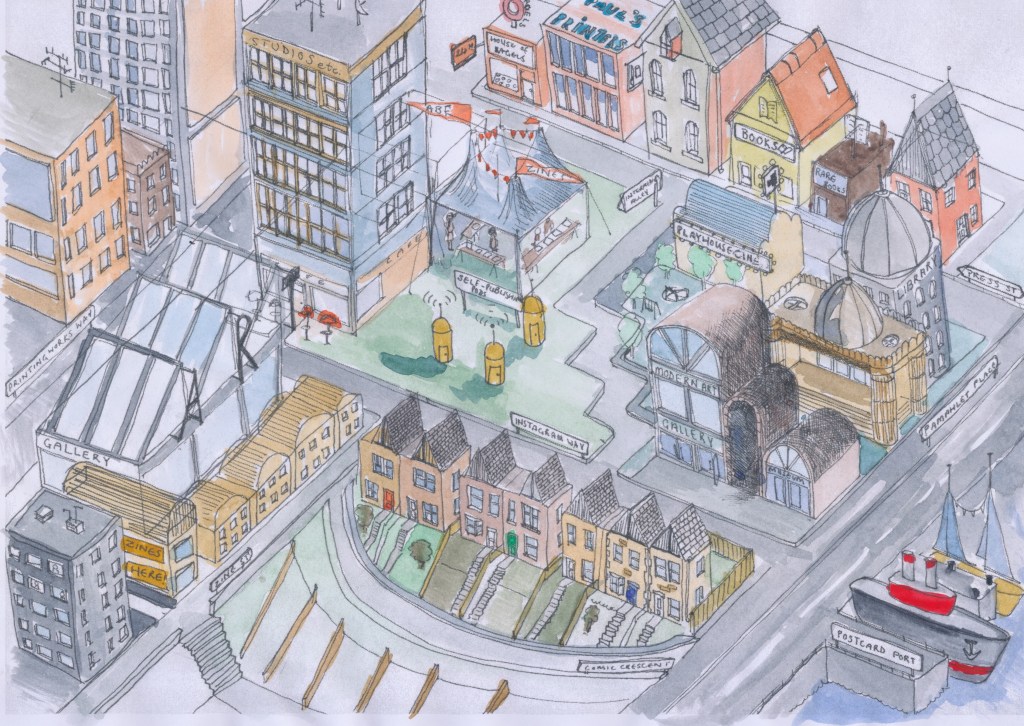
Research Town is a conceptual map of my research interests at the intersections of publishing studies and visual arts fields of research and practice. Scanlon (2021) usefully outlines the meanings and functions ascribed by scholars to the diagram. Citing Deleuze (1988), Scanlon highlights the ways in which the diagram represents a moment, the nature of which however is not static and is under a processual development:
“every diagram is intersocial and constantly evolving. It never functions in order to represent a persisting world but produced a new kind of reality, a new model of truth.”
Deleuze, 1988. Foucault. Trans. and ed. Seán Hand. Minneapolis: University of Minnesota Press. p.35.
Developments in definitions of the diagram since Deleuze, are shown in philosophy and in art history to include, “the embodied, material and processual image.” (Scanlon, 2021: 166). My understanding of Research Town as a diagram follows the definitions and the understanding posed by Scanlon (2021: 166), not “for its functional structures – triadic, quadratic, Venn, flow” etc., but as a “generative apparatus.”
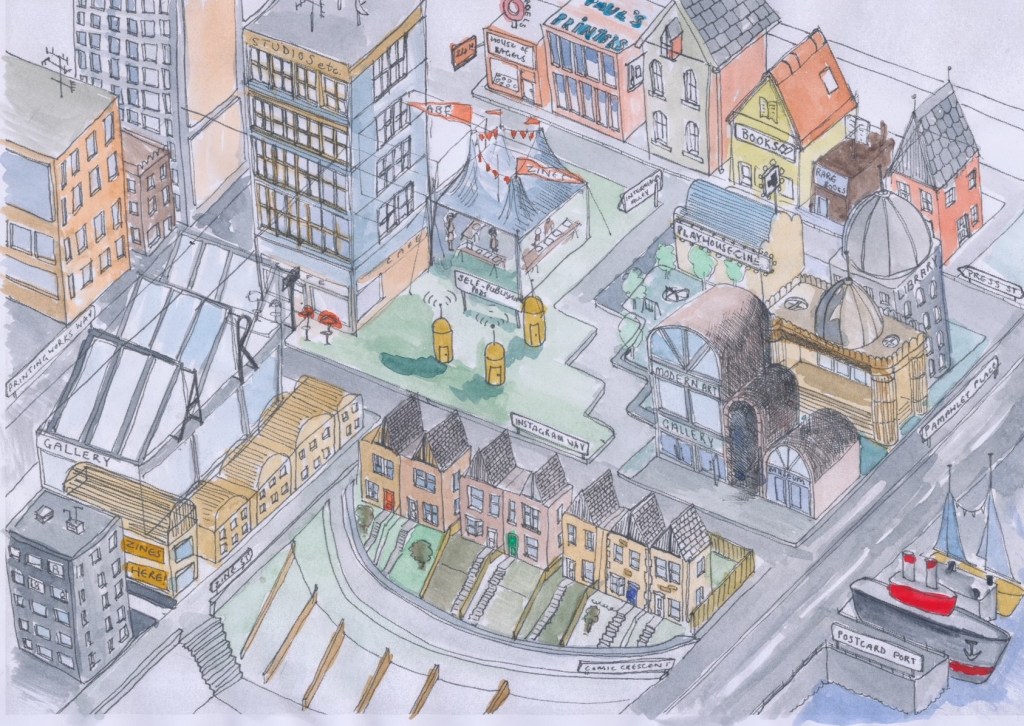
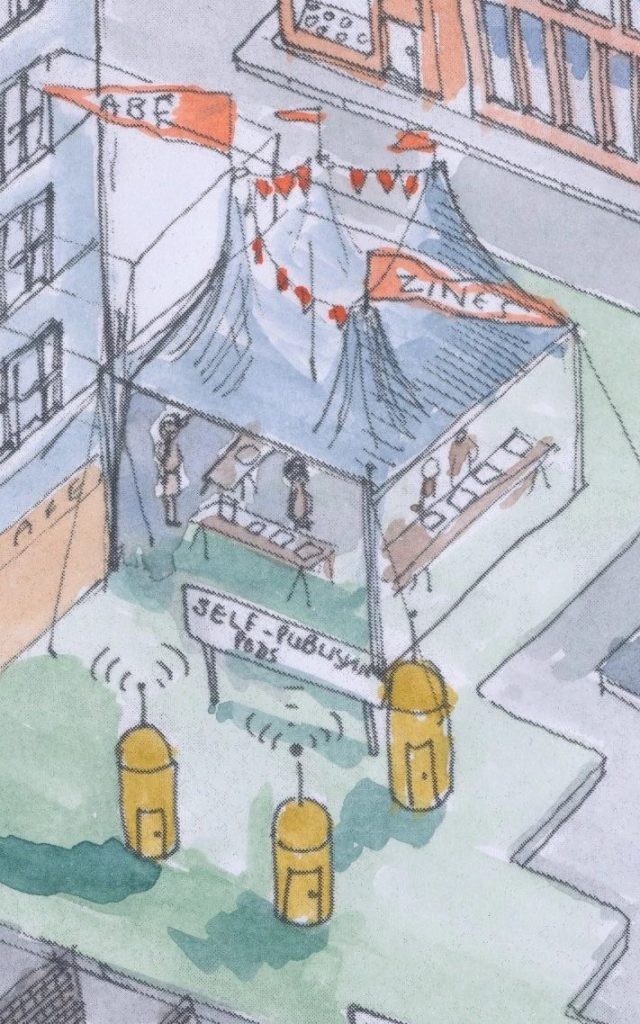
Research Town (the drawing above) depicts a place derived from my research explorations into publishing and self-publishing activity within the visual arts where the streets are named after notable elements of activity in this area of art-publishing: Comic Crescent, Instagram Way, Printing Works Way, Press St, Pamphlet Place, Postcard Port, Zine St, and Intermedia Alley. Postcard Port alludes to there being more of these towns elsewhere, a connection to other networks of similar kinds of activities (or different). The streets are connected amongst buildings of use for the town’s inhabitants and sections of the town where certain types of work might go on. The artist book fair (ABF) is represented by the tent structure sitting next to the studios block, signified by the flag with ABF on it and characterised as a fair by the bunting draped across the tops of the tent poles. Comic Crescent is envisaged as a row of semi-detached Victorian villas, reflecting to a degree, although not for certain in the same architectural spaces, where a lot of comic making happens, in comic maker’s houses. Intermedia Alley reflects the mix of mediums, formats of paper books, e-books for example, and types of media involved in activities in this area, for example, film, press articles, etc. Zine St. and Pamphlet Place reflect the print culture happening here too. Alongside Postcard Port, these street names reflect the zine, pamphlet and postcard publications that are often ephemeral, momentary and less long-lived than their counterpart publications in Research Town, which may be housed in the library, or art gallery buildings. Of course socialising in an important part of Research Town and the bagel and coffee shops as well as the cinema and the rare book shop aim to reflect the importance of the mix of socialising and entertainment with specialist interests in book history, art, film and cinema for the inhabitants of this town.
Inspired by Italo Calvino’s Invisible Cities (1972), Research Town could, and likely will, take on multiple representations in its’ architecture, place names and the events taking place.
 Research Town