It has been a while since my last update on this research project on ‘Contemporary Art-Publishing Ecosystems of Remote and Rural Scotland’. It’s March already but I have been busy undertaking three research trips to the Isle of Skye: two weeks in November 2024; ten days in January 2025 and; ten days in February 2025. I have gathered a lot of information from people I have talked to and inspiring experiences that I have had. Needless to say, the research has been progressing apace and these blog posts have struggled to keep up in amongst teaching commitments as the Spring semester leaped into gear in mid-January. These include teaching on my newly developed optional module, ‘Experimental Publishing‘, on the MLitt Publishing Studies programme at the University of Stirling.
However, now that I have cleared my throat of what feels largely like excuses for my absence on here, I do have some updates to share. This post presents some images that are testament to the geographical and seasonal transitions of my experiences undertaking fieldwork in Birnam, Perthshire, in Portree, Isle of Skye and the surrounding locales. Zine making and print publications, both gathered and produced, in the form of Fount for example, have been part of this experience. Poetry I have experimented with in my writing and the poetry of others I have read and experienced for example on the Corbenic Poetry Walk or at the Magic Mountain Festival are also touchstones in my research during this period (November 2024 – March 2025).
Place, poetry, publication
In a cold but sunny day in November last year I walked around the Corbenic Poetry Path. The poetry path is situated in the grounds of Corbenic Camphill Community, which meant that our dog Luna could some along. My husband and son joined me too. The path is around 3km long. It winds around the grounds of the Corbenic Camphill Community estate and as you walk along it you encounter lots of creative works, some which take you by surprise, some that speak to the surroundings that they are situated in very poignantly like this one (figure 1). The text reads:
“The people who settled here, faces etched deep by distant lives, scored by work and weather.”
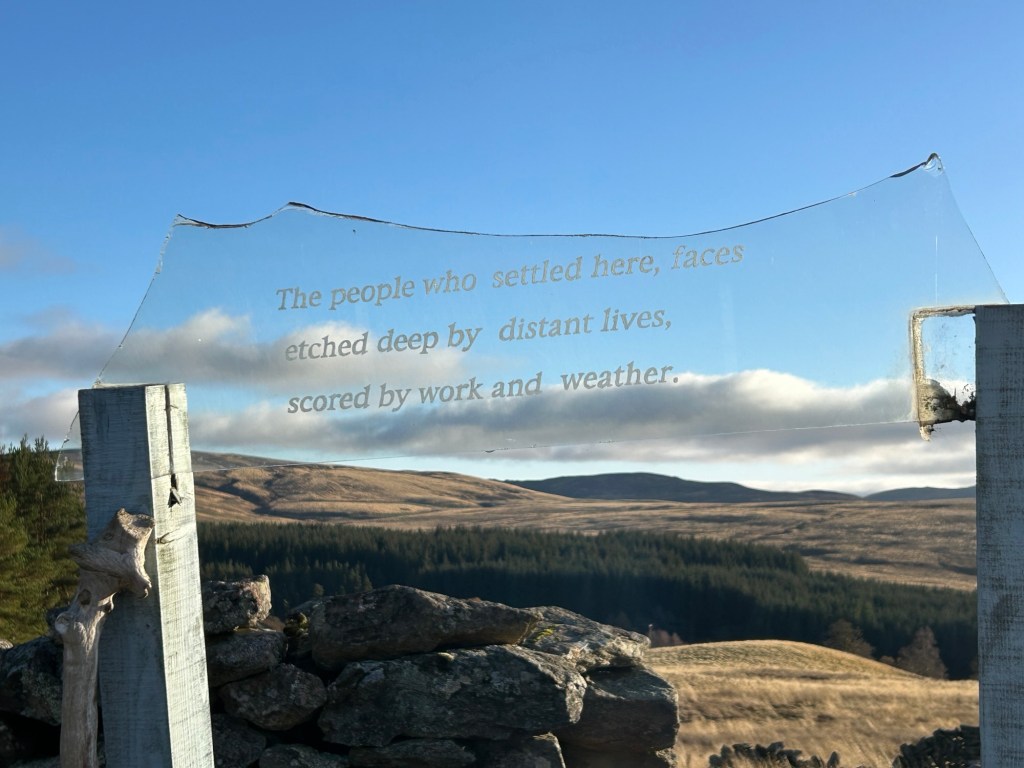
The letters are etched onto the face of a piece of glass, which is a large shard of a shattered pane of glass, mounted on two posts which are positioned next to the ruins of what appear to have been at one time a stone building, a home I think. The view down the valley at the time when that building was in use would have been wonderful to wake up to. I couldn’t help but wonder who lived in that place and when it fell into disrepair.
As well as poetry, we encountered an abstract stone sculptural work which reminded me of the canisters storing the ominous looking black liquid in Ridley Scott’s 2012 film Prometheus. When viewing the sculpture, this notional idea of the seed and the potential for life inside it came through to me (figure 2). The sculpture was carved to an exacting geometry with a rough edge on the outside and the inside smoothed to a fine polish (see figure 3). Another stone sculpture, a carved Gaelic knot, was suspended from trees in the woods. In a moment looking up close at the stone sculpture then beginning to walk away I realized that the same Gaelic knot was somehow inscribed in the ground below us (figures 4 and 5).
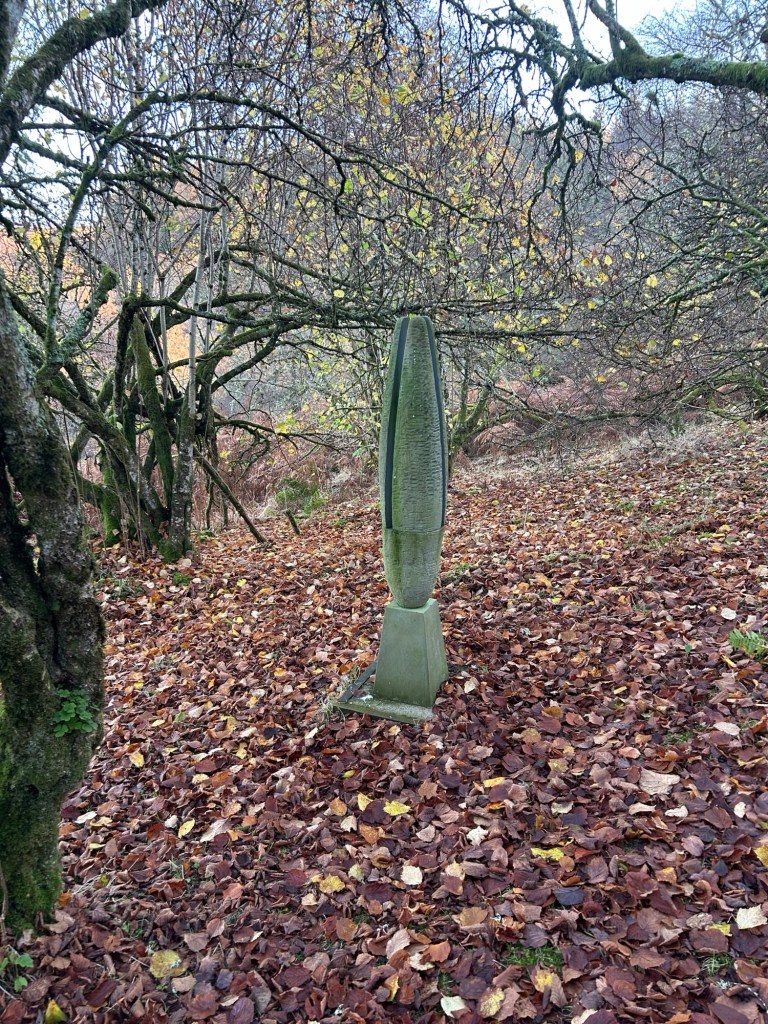
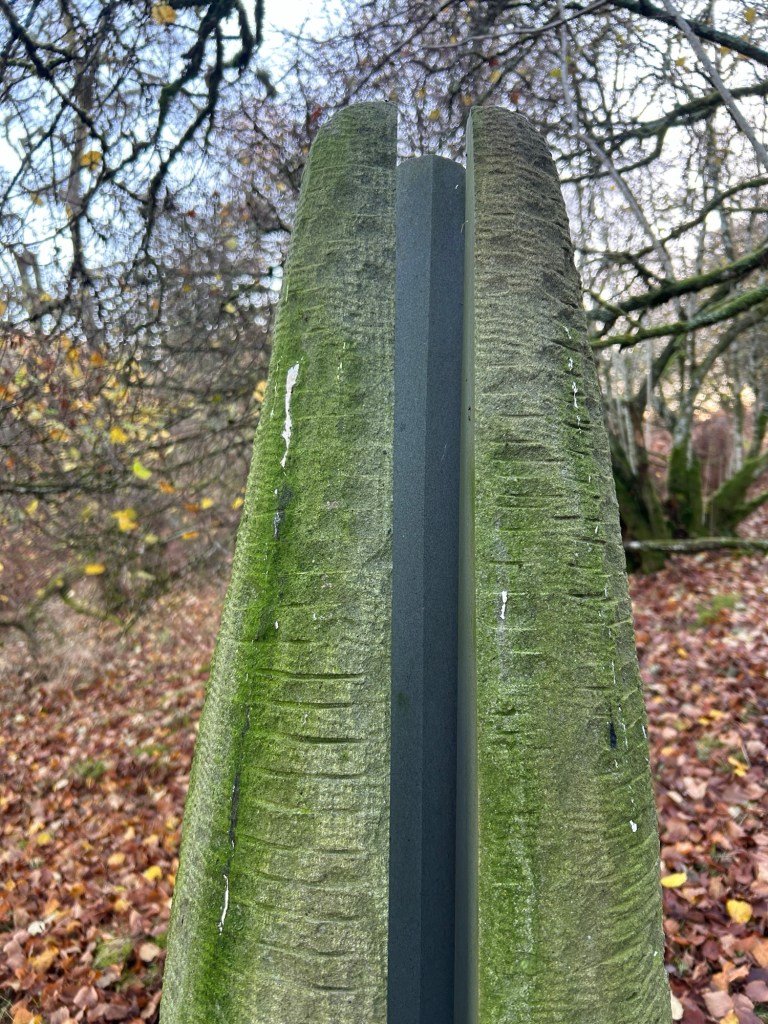
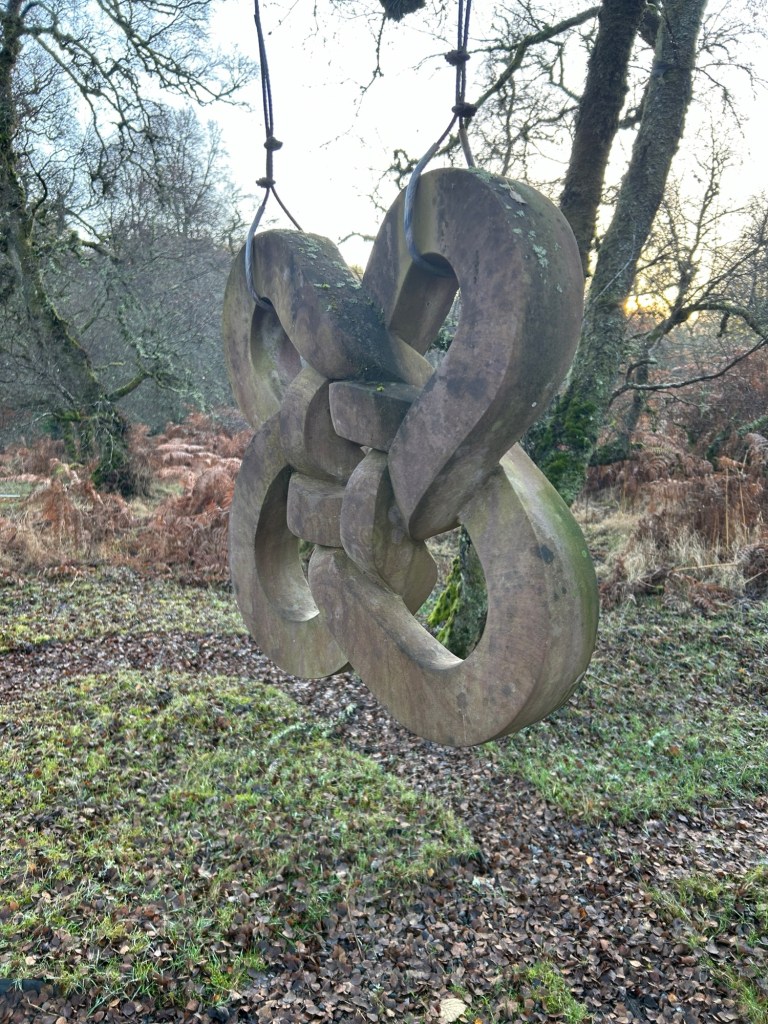
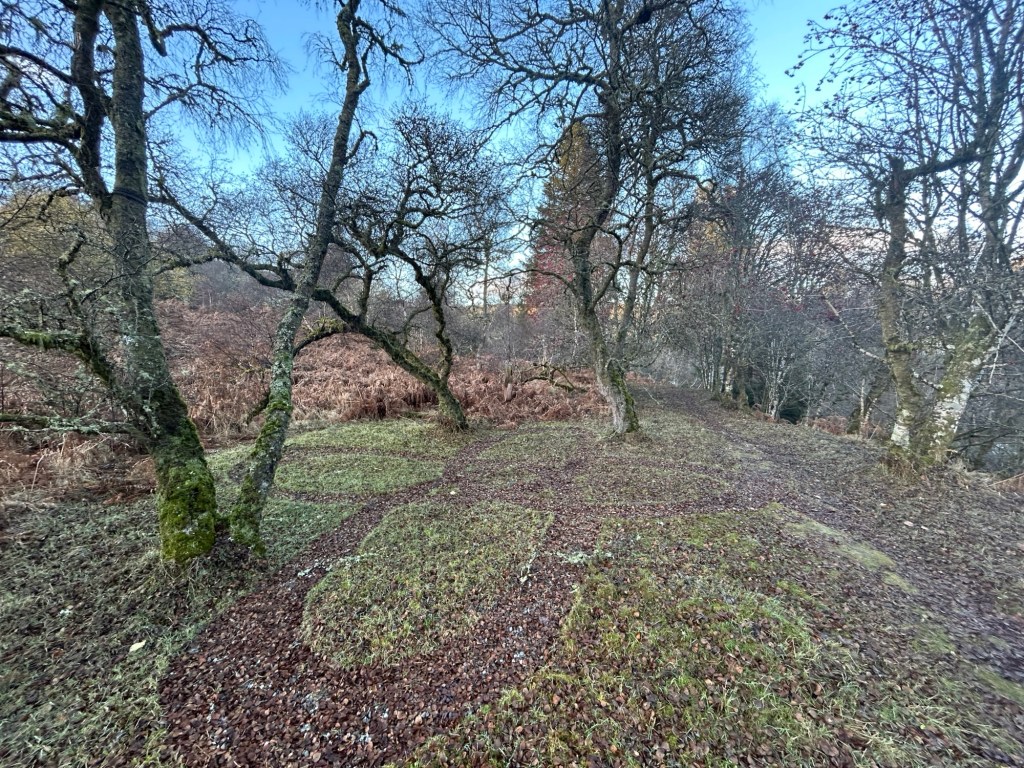
The Poetry Path created such a beautiful experience for us that we will remember it for a long time. The encounters with each poem were enriched by the weather for us that day, and our consequent jubilant mood that the discoveries along the path created for us. These ‘texts’ the words and the sculptural works published in this way are at once embodied and completed by their situation in the landscape in which they are encountered. I felt that the artworks were waiting for us to be discovered and enlivened by our reading of them in ways which far outreach the experience of a reading from the pages of a book.
Zines and Fount magazine making in the Isle of Skye
From the hills of Perthshire in November, I made my first research trip to Portree. I stayed at the nearby Glen Bernisdale, around 7 miles north of the largest town of the island. The route from Perth took me north on the A9 past Pitlochry and Blair Atholl. I then turned left towards Roy Bridge and Spean Bridge, where I turned right to travel towards Invergarry where I turned left again after Laggan on the A87 towards Glen Moriston before turning left to drive past Loch Cluanie driving through the valley of Aonach air Chrith (1021 m high) on the left and A’ Chralaig on the right before Sgùrr Fhuaran (1068 m high). Whilst driving through this valley a low flying bomber plane – huge – was doing a training flight which was breathtakingly loud as it swooped past, impossibly low to the ground. From clearing the mountain pass following a line of cars driving very slowly at around 40mph the road came out to the sea lochs of the west coast, approaching Inverinate and Dornie before reaching Kyle of Lochalsh. The Isle of Skye can be reached by road via the bridge crossing from Kyle of Lohalsh. There is still a ferry crossing but that route is closed in the winter months.
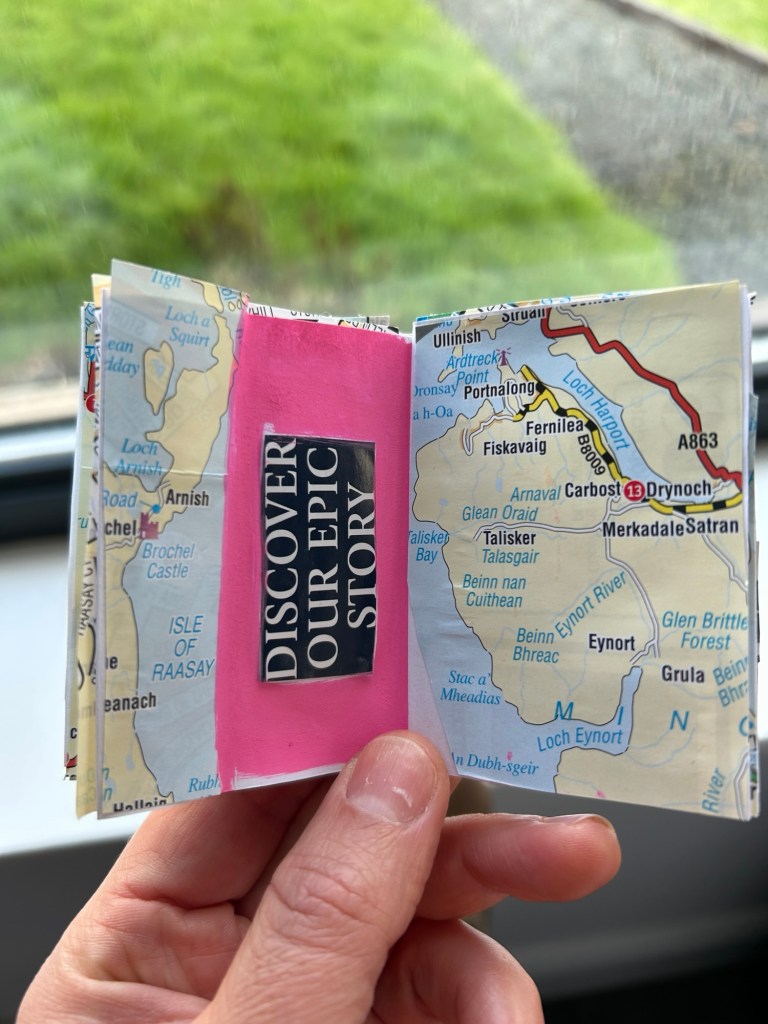
To help get my bearings I explored Portree on foot. The visitor information office was open. I found helpful maps and leaflets there advertising boat trips, artist studios around the island, walks to do and some historical information. Hidden Scotland is a publication I discovered which has useful information intended for the visitor to Scotland of local shops and places to eat and stay. I took the leaflets I had gathered and made a pocket sized zine simply titled ‘The Isle of Skye’ (figures 6 & 7). Making this zine helped me to focus on the details of the map, and familiarize myself with the place names. In amongst talking with the team at Atlas Arts, the central arts organization of my case study here in Skye, I was also beginning to draft my first issue of Fount magazine for this project – which is looking set to be printed any day in this month of March 2025 and should be available to download from this website soon!

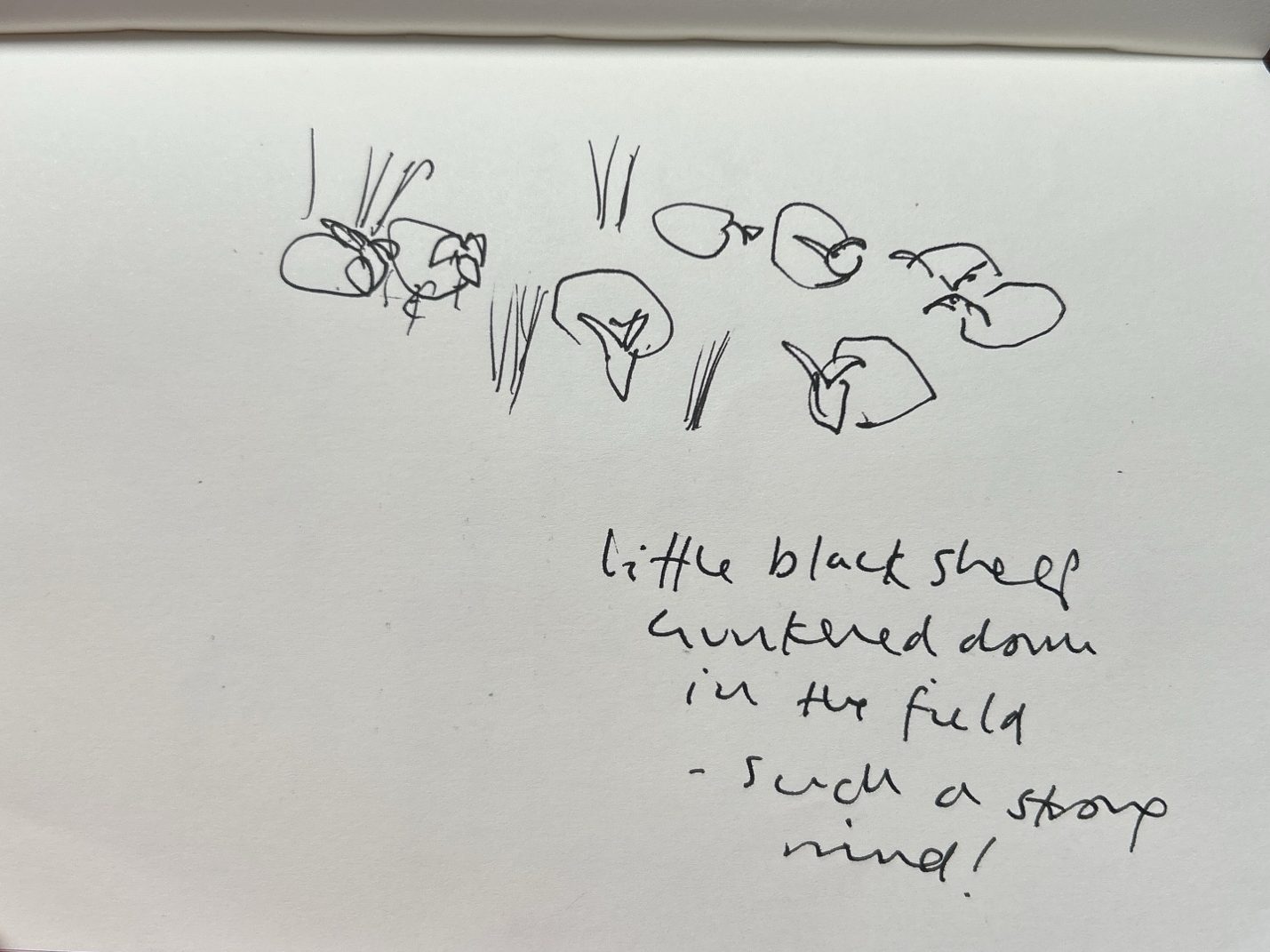
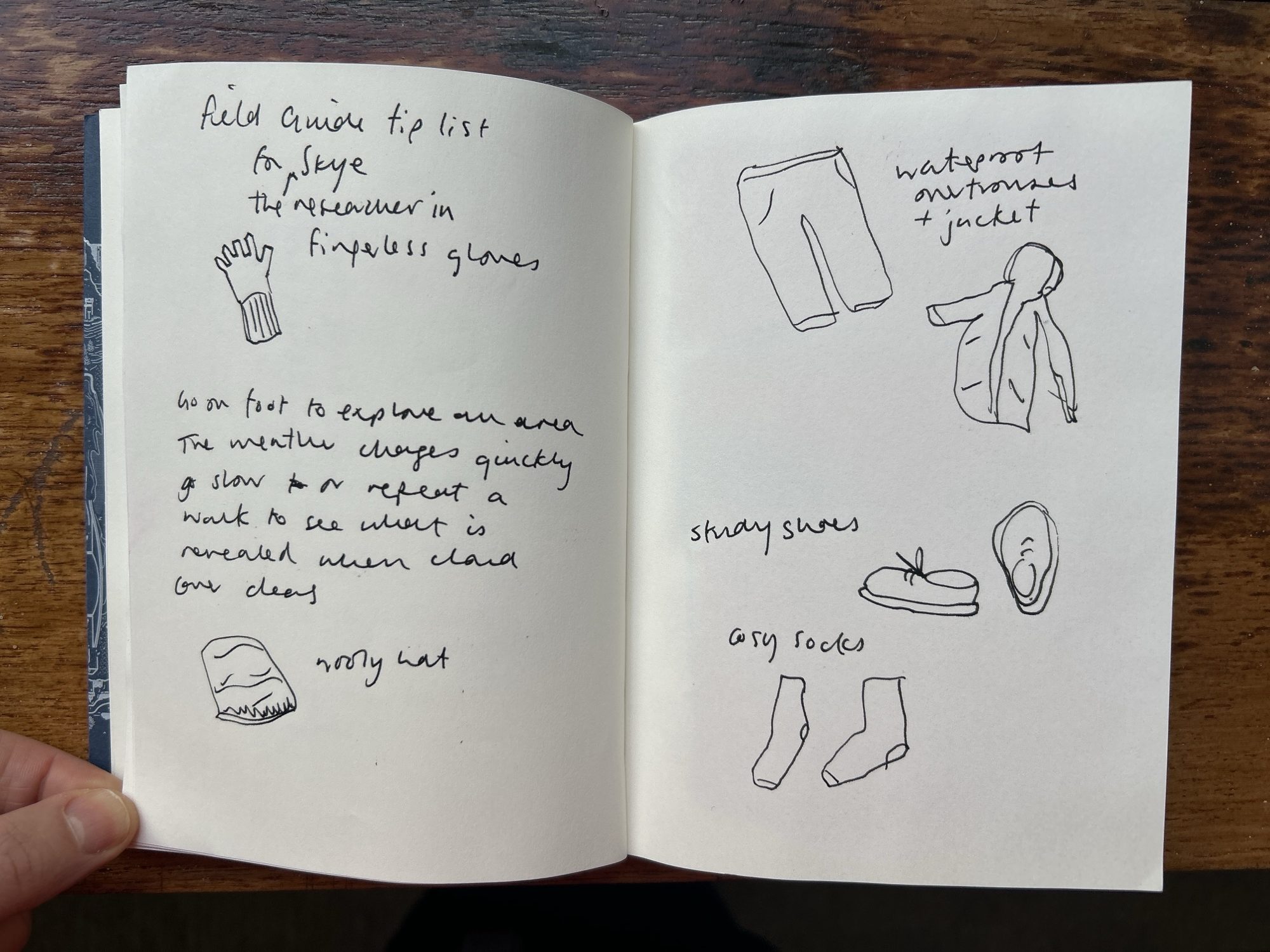
Into the new year 2025, I made my second research trip to the Isle of Skye. This time to stay a bit further north of Portree and Glen Bernisdale (where I stayed in November) in a place called Flashader. I drove through the snow in what was a painfully slow journey. I arrived in the dark but in one piece. My production of Fount increased in pace during this trip, and I wrote the majority of the content in amidst various trips to Portree to interview people for my research and visits to the Skye and Lochalsh Archive Centre. The skies were bright blue on the clear days which were also bitterly cold. I managed to make some sketches during some short walks outside, of the little black sheep hunkered down sheltering from the wind (figure 8) and a ‘Field Guide Tip List for the Researcher in Skye’ (figure 9). One of the tips reads, “Go on foot to explore an area. The weather changes quickly, go slow or repeat a walk to see what is revealed when cloud cover clears”.
The Magic Mountain Festival which I attended during my most recent research trip to Skye from 26 February to the 9 March 2025 marked the transition of our days becoming longer as Spring draws closer towards us. There is more to write about that in terms of place, poetry and publication so I’ll be giving it space in a separate blog post next. But in pausing here, this post has I hope given an impression of the transitions I have made in and across the land from Birnam to the Isle of Skye, between November 2024 and January 2025, connected with our experiences through the written word, the publication and the simple gestural sketch as I continue to develop this research in Contemporary Art-Publishing Ecosystems of Remote and Rural Scotland.
 Research Town
Leave a comment