Due to a last minute space that became available, I booked on to the linocut workshop that Linda Farquharson organised. I felt a draw to it. That trying out linocut printmaking was going to be good for my work and for myself. It had been at least twenty years since I had done any printmaking. In 2003, I spent the autumn semester of the third year of my fine art degree at the Nova Scotia College of Art and Design in Halifax, Canada. Whilst there, I learned Intaglio (also known as plate etching) and stone lithography printing processes. I hadn’t had an opportunity to revisit printmaking since. Linda has a wonderful reconditioned Columbian Press. Pathfoot Press in Stirling University has one similar, if not the same.

I looked forward to meeting other creative people at this printmaking workshop and making some prints myself again. I felt that this traditional handmade connection to printing and book making via the Columbian Press, in conjunction with contemporary artists’ practice was interesting to document as part of current research into remote and rural art-publishing ecosystems in Scotland. I’m building a list of rural based printing presses and so far I have two: Linda’s private studio press in Trochry and The Quarto Press in Coupar Angus. There may well be more, I’m sure!
The workshop I participated in took place on Sunday 6 October. This was around one week after my second period of fieldwork at Birnam Arts (BA). I am finding that workshops are important for the community to come together and to share connections through the making and doing of the project in focus. I attended Linda’s linocut workshop to experience the printmaking process, but to also develop and play with some of the connections in the research to fungi, something that Beatrix Potter was interested in. Anyone who lives in or visits Birnam will have observed all the fungi in the forests. You see the mushrooms situated along the river or by the paths in the hills devouring dead trees. I won’t be the first one who is interested in the networks of fungi and the amazing connections that this organism has with the living forest and the ecology it is part of. This interdependent relationship is similar I think to those relationships that I see amongst workshop participants, the organisers and leaders, and their network of creative practices in their community – a creative ecology if you will.
This workshop gave me an opportunity to experience linocut printing and learn more about why others do it as well as how they do it and where to get materials from. As participants, we brought along some sketches of our ideas to work with and we were given the materials that we needed to complete our prints. I brought my sketches of fungi and how I imagine they connect underground. I like the shapes and colours of the fungi but have no real knowledge about them at all. Very quickly I settled on the printed image I would create in discussion with Linda over my sketches in my book.
I used tracing paper to draw out the image and transfer it to the lino. Then I spent the morning fuelled by coffee and homemade biscuits cutting into the lino to make my marks that would eventually create my print. Relief printing means that the marks that you cut away become the colour of the paper rather than the inked line. This is a tricky transition to make in my mind. Any words or letters also need to be created in reverse in order for them to appear as they should as the print is a mirror image of the linocut image.
After a nourishing lunch cooked and supplied by Linda, including homemade crackers and soup and a delicious selection of cheeses and figs and honey, we went back to her workshop to get on with some printing. My resulting prints were an experiment with printing the image all black and then sectioning the print in two with some of it printed in blue and another part printed in black. Some of these worked well and others didn’t.
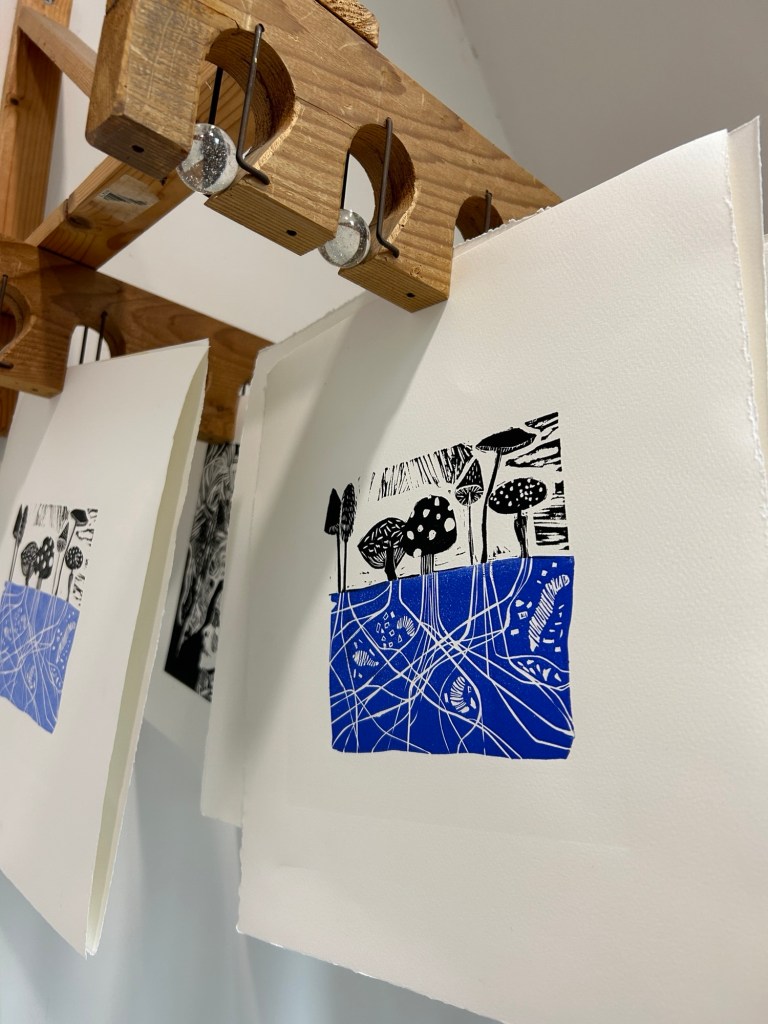
This printmaking day was a taster, a short window of time into a practice that for Linda is so much longer and ongoing. We chatted about materials and process while cutting the lino and I left the workshop feeling very tired from the work but energised by the connections we made through creating images on this beautiful refurbished Columbian press.
 Research Town
Leave a comment